


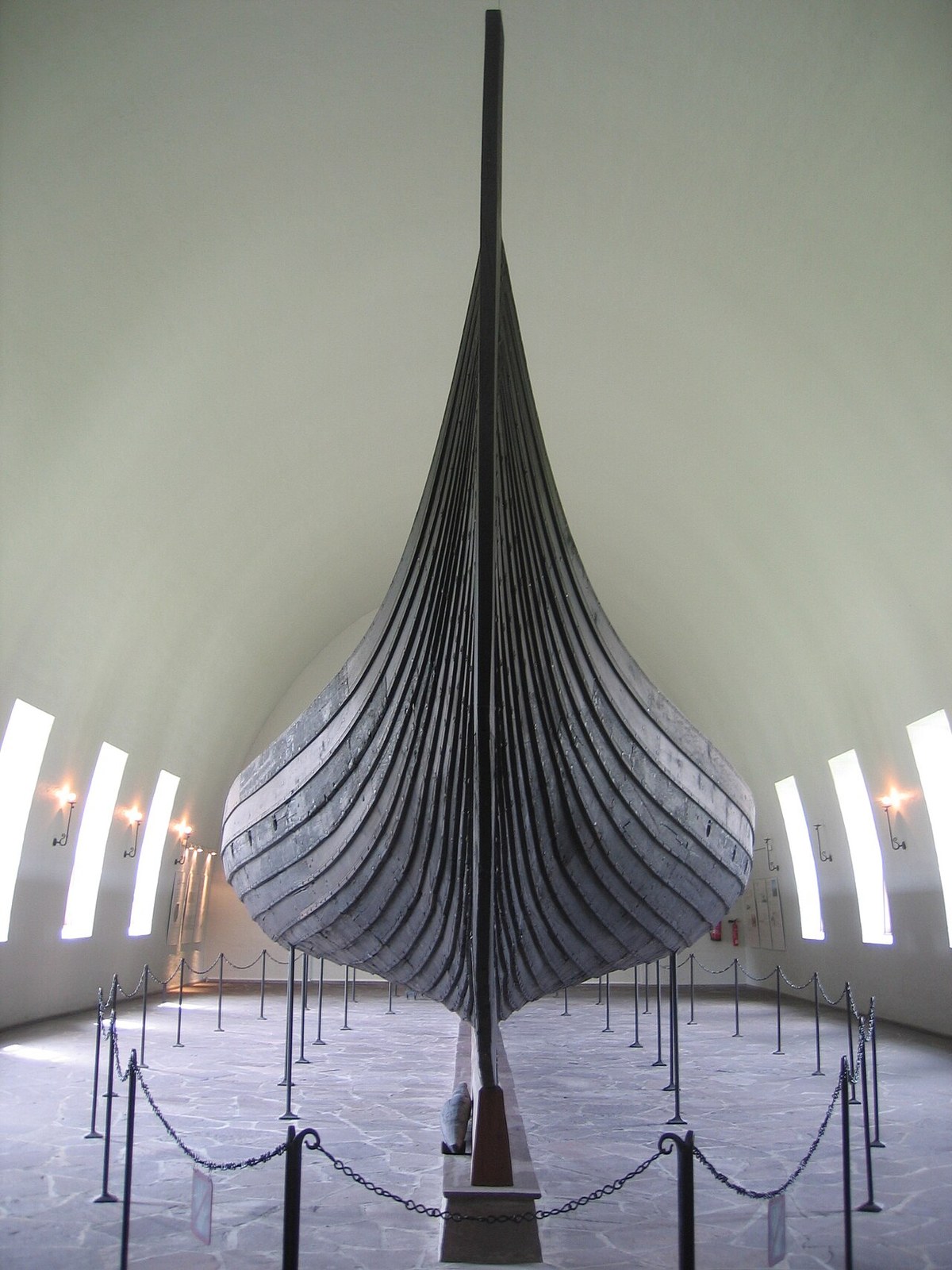
At the dawn of the early medieval era, the Scandinavian longship materialized as the pinnacle of northern naval architecture, enabling Norse mariners to dominate European waterways and execute transoceanic voyages of unprecedented daring. Ranging from coastal raids along the British Isles to the colonization of Iceland and Greenland, the exploration of Vinland in North America, and deep riverine incursions into Eastern Europe toward Byzantium, the longship was an instrument of peerless speed, hydro-elastic resilience, and tactical flexibility.
The structural triumph of the longship lay in its lapstrake, or clinker-built, hull construction. Rather than adopting the heavy, rigid skeleton-first carvel method employed in the Mediterranean, Norse shipwrights built the shell outward from a robust T-shaped oak keel. Broad, radially cleaved oak strakes were overlapped and fastened together with clincher-hammered iron rivets, caulked with spun wool or cattle hair impregnated with hot pine wood tar. Lightweight internal rib frames (spant) and transverse crossbeams were subsequently lashed or pegged to the strakes using flexible spruce roots and treenails. This ingenious articulated joinery allowed the longship's hull to flex, twist, and undulate organically across brutal North Atlantic swell regimes, dissipating destructive wave energies that would have sheared rigid hulls apart.
The procurement and metallurgy supporting longship construction represented a vast logistical enterprise. Fabricating a large thirty-meter longship, such as a skeid or royal drakkar, required over seven thousand hand-forged iron rivets and clinch plates. Norse smiths extracted malleable, low-carbon bloomery iron directly from local bog ores (myrmalm), producing ductile fasteners that bent elastically under shear strain rather than snapping brittlely. Furthermore, master builders combed ancient oak forests for 'grown timbers'—naturally curved trunk-and-branch junctions harvested to fashion floor timbers and structural knee brackets without cutting across the natural grain lines. In parallel, earthen tar kilns (tjärdalar) pyrolyzed tons of resinous pine stumps, yielding barrels of hydrophobic pine tar essential for sealing hull planking against naval shipworms (Teredo navalis).
The longship’s hull geometry exhibited extraordinary amphibious versatility. With an extremely shallow draft often measuring under eighty centimeters and symmetrical double-ended profiles, longships navigated turbulent coastal surf and penetrated hundreds of kilometers up shallow continental river basins such as the Rhine, Seine, Dnieper, and Volga. The absence of a deep fixed keel allowed crews to execute immediate amphibious beach assaults, landing directly on unprepared shingle shores without requiring docks, wharves, or deep-water anchorages. Furthermore, the light total displacement permitted overland portage, enabling crews to drag their vessels over log rollers across watersheds connecting distinct river systems.
Propulsion was seamlessly hybridized between aerodynamic sail power and direct human rowing. A single central pine mast hoisted a broad, heavy square sail woven from dense vadmal wool, often treated with animal fat and ochre to shed icy spray and reduce porosity. When headwinds prevailed or tactical speed was mandated during naval engagements, up to thirty-four pairs of oarsmen manned long pine oars passed through circular oar ports (skatträ) equipped with internal pivoting wooden shutters that sealed out ocean spray under sail. Course management was governed by a single heavy steering oar, or side-rudder, secured to the starboard aft quarter via an elastic willow grommet, providing instantaneous helm authority in rough seas.
Navigational methodology across open subpolar waters operated without magnetic compasses or nautical charts. Norse helmsmen developed sophisticated dead reckoning combined with observation of ocean currents, whale migratory behavior, and coastal bird flights. Navigators employed calcite crystals—the legendary 'sunstones'—to detect the polarization angle of sunlight through overcast Arctic cloud banks, cross-referencing azimuths with wooden bearing dials.
Life aboard an open-decked longship subjected crews to unrelenting exposure. Sailors endured sub-zero spray, sleeping under waterproof oiled-hide bivouac sacks (hudfat) on removable decking boards while rowers' storage chests doubled as rowing benches. Shields mounted along the gunwales (skjaldrim) provided essential freeboard and missile protection during battle. The longship stood as an unassailable synthesis of organic engineering and maritime boldness, irrevocably shaping the historical geography of the medieval world.























































