


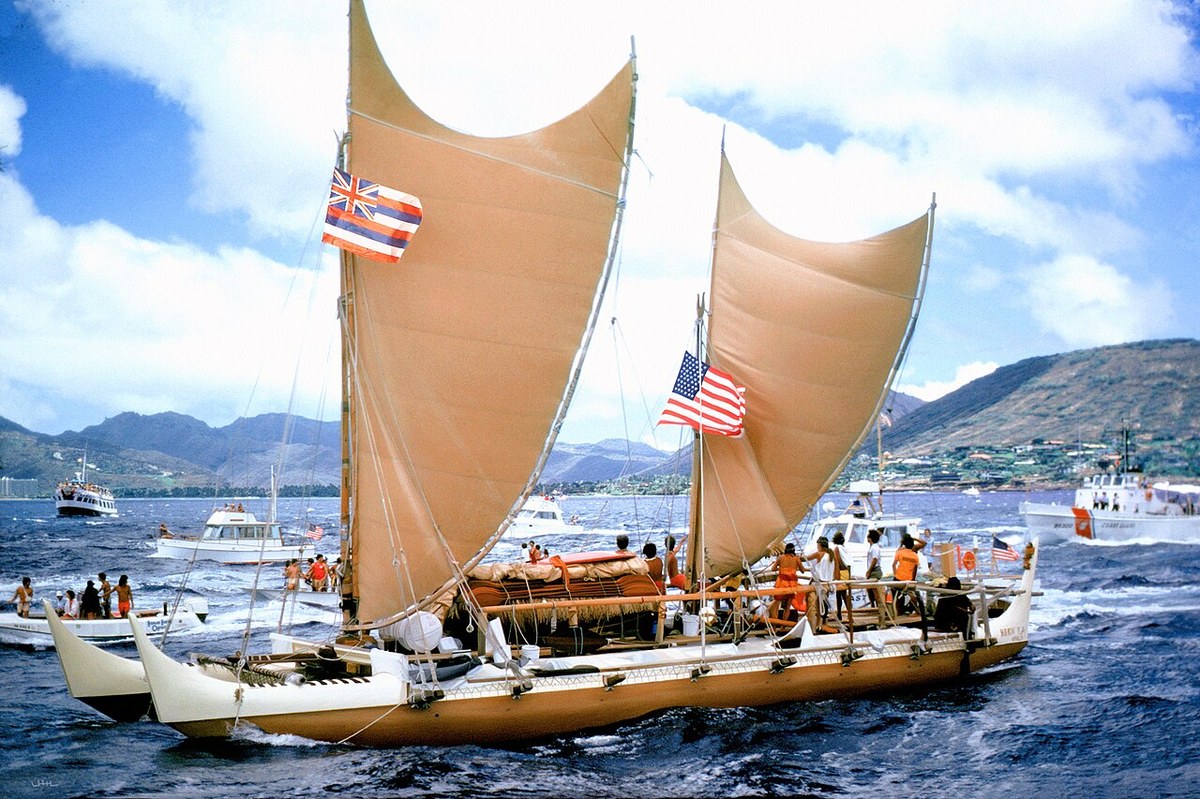
Centuries before European mariners developed the marine astrolabe and ventured nervously into the open Atlantic, ancient Austronesian navigators had methodically colonized the vast Polynesian Triangle—a ten-million-square-mile expanse of open Pacific Ocean stretching between Hawaii, Easter Island, and New Zealand. At the core of this monumental maritime achievement stood the double-hulled voyaging canoe, known in the Hawaiian archipelago as the 'waʻa kaulua' and across the Cook Islands as the 'vaka purua.' Combining hydro-elastic naval architecture with ingenious non-instrument navigational science, these vessels conquered the largest ocean on Earth.
The structural foundation of the voyaging canoe utilized an asymmetrical catenary twin-hull design. Master woodwrights hollowed twin streamlined hulls from massive trunks of koa, totara, or breadfruit trees, occasionally raising the gunwales with stitched wooden planks to increase freeboard and prevent swamping. Rather than adopting the rigid metal fastenings characteristic of European shipbuilding, Polynesian builders lashed the hulls to heavy transversal hardwood crossbeams using thousands of meters of hand-braided sennit cordage crafted from coconut husk fibers. This articulated structural joinery imparted vital elastomeric compliance, permitting the twin hulls to independently torsionally twist and flex over giant oceanic swells without fracturing under severe shear stresses.
Hydrodynamic stability and course-keeping were governed by hull geometry and massive steering oars rather than deep weighted keels. The slender V-shaped cross-sections of the twin hulls acted as lateral foils, resisting leeway and side-slip when beating into windward swells. Heading control was maintained using massive six-meter steering oars known as 'hoe uli,' mounted at the stern quarters and actuated via braided rope tackles. When heavy squalls crested the gunwales, crew members operated bailers carved from kou wood, continuously evacuating seawater while maintaining precise sail trim.
Propulsion and aerodynamic efficiency centered around twin masts hoisting triangular crab-claw sails woven from dried pandanus leaves. The distinctive curved spars of the crab-claw rig acted like modern high-lift swept wings, generating extraordinary aerodynamic vortex lift at high angles of attack and enabling the vessels to sail aggressively close-hauled into headwind trade winds. A wide slatted timber bridge spanned the crossbeams, carrying a central sleeping deck shelter, stores of dried fish and fermented poi, freshwater gourds, open sand-filled hearth fireboxes, and potted rootstocks of taro, yam, and sugarcane wrapped in damp moss to sustain nascent colonies.
Voyagers crossed thousands of nautical miles through wayfinding—a rigorous empirical discipline of celestial and environmental navigation devoid of metal compasses, clocks, or paper charts. Master navigators aligned the canoe’s heading against an internal thirty-two-point star compass defined by the rising and setting azimuths of navigational stars, planets, and constellations crossing the celestial equator. By day, navigators analyzed subtle deep-water wave swells that had traveled undisturbed across oceanic basins, reading how submerged island masses refracted and bent swell harmonics hundreds of kilometers beyond the physical horizon. Navigators further tracked the dawn departure and dusk return flight bearings of indigenous seabirds such as the white tern and noddy, which reliably signaled the proximity of dry land.
Archaeological and genetic evidence confirms that Polynesian voyaging was not a desperate one-way flight, but an organized program of deliberate two-way exploration and planned colonization. Expeditions carried carefully balanced demographic crews of twenty to sixty men, women, and specialists, alongside breeding populations of domestic pigs, dogs, and junglefowl. Upon discovering pristine archipelagos, navigators memorized the return coordinates and sailed back thousands of miles across prevailing winds to guide fleets of sister canoes to the newly claimed homelands.
The cultural and logistical endurance of the Polynesian voyaging canoe was vindicated in modern history through the 1976 maiden voyage of the replica Hōkūleʻa. Guided exclusively by master navigator Mau Piailug across four thousand kilometers of open equatorial water from Oahu to Tahiti without mechanical instruments, Hōkūleʻa dismantled outdated colonial theories of accidental drift, establishing Polynesian voyagers as the supreme transoceanic mariners in human history.























































