


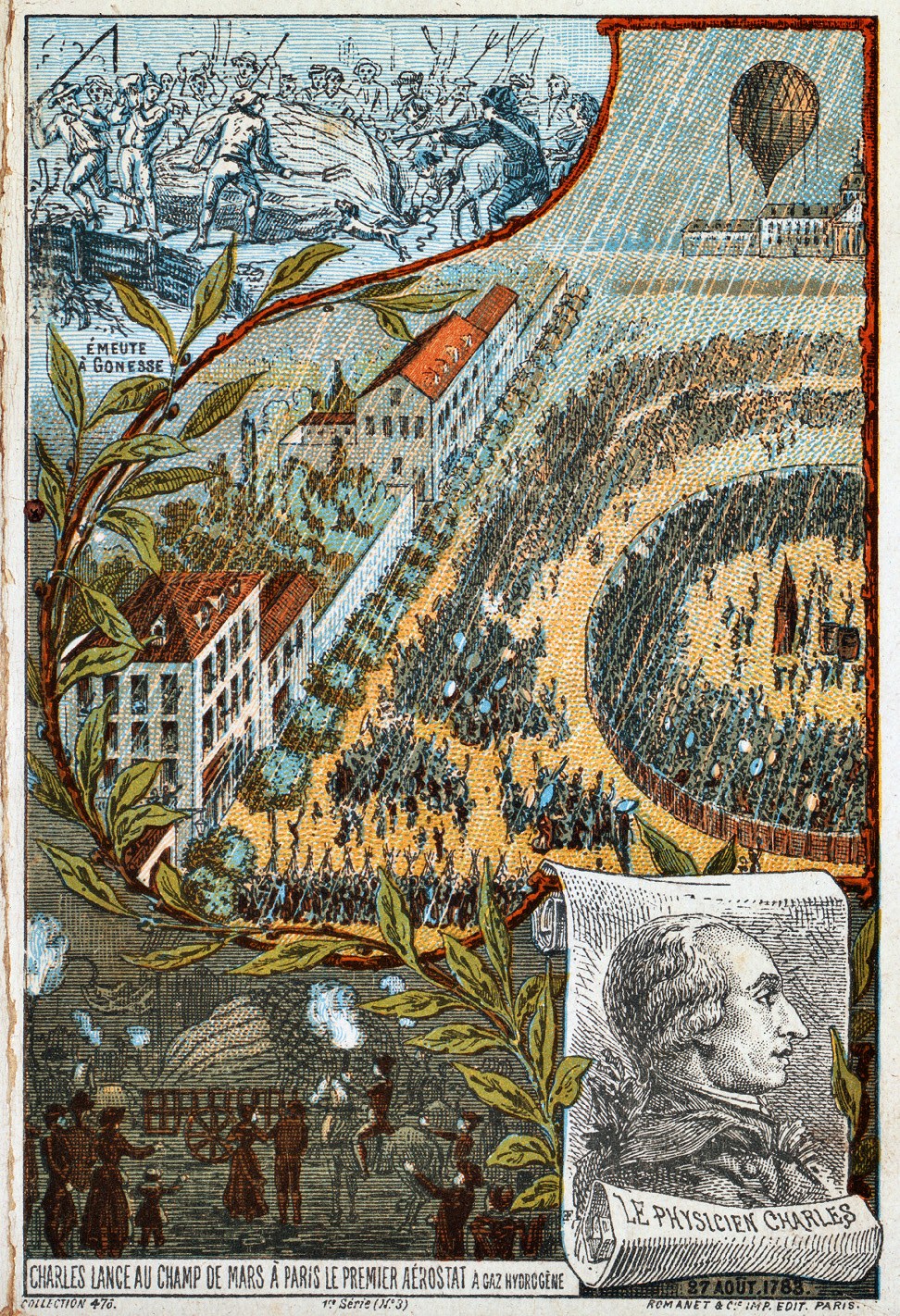
While the Montgolfier brothers relied on hot, smoky air, French physicist Jacques Charles realized that Henry Cavendish's recently isolated 'inflammable air'—hydrogen gas—offered far superior lift without requiring an active fire on board. On December 1, 1783, Charles launched the Charlière from the Tuileries Garden in Paris before four hundred thousand spectators. Constructed from silk coated with dissolved natural rubber to prevent gas leakage, his balloon introduced features still used in aerostats today: a wicker passenger gondola suspended by an enveloping net, a valve line to release gas for descent, and a mercury barometer to calculate altitude.























































